The Metallurgic Art of Revival: A Definitive Treatise on the Stainless Steel Body Gua Sha as the Pinnacle of Modern Manual Therapy for Face and Body
Introduction: The Confluence of Ancient Wisdom and Modern Material Science
In an era dominated by electric gadgets and complex cosmetic chemistry, a profound return to manual, instrument-assisted healing is taking root within the wellness and aesthetics communities.
This renaissance is not a rejection of science, but rather its intelligent application to enhance ancient practices. At the forefront of this movement is the Gua Sha tool, a modality with origins deeply embedded in Traditional Chinese Medicine (TCM).
For centuries, practitioners used simple tools—often horn, bone, or smoothed stones—to scrape the skin to release stagnation, encourage circulation, and promote the free flow of Qi, the vital life force.
The modern iteration of this tool, however, has been revolutionized by the adoption of advanced materials, most notably medical-grade stainless steel. This discourse is dedicated to a comprehensive exploration of the stainless steel Gua Sha, transcending its common perception as a mere “face stone” to reveal its identity as a sophisticated bio-mechanical instrument.
We will delve into the material supremacy of steel, the multifaceted ergonomics of its design, its precise physiological mechanisms of action, and its expansive utility beyond the face as a premier body gua sha tool.
This treatise will establish why this specific implement represents the optimal fusion of ancestral knowledge and contemporary engineering, creating an unparalleled device for holistic self-care.
Chapter 1: The Elemental Core – The Supremacy of Stainless Steel as a Healing Medium
The foundational element that distinguishes this tool is its composition. The claim of being “made of high-quality steel” is a vast understatement of its critical importance.
Section 1.1: Material Properties and Biocompatibility
Medical-grade or surgical stainless steel (often 304 or 316L grade) is an alloy engineered for exceptional performance in biological environments. Its properties include:
-
High Durability and Structural Integrity: Unlike porous stones like jade or rose quartz, which can chip, crack, or absorb impurities, stainless steel is “durable” to an extreme degree. It is resistant to impact, pressure, and torsion, ensuring the tool maintains its precise structural form indefinitely.
-
This makes it a “face massage stone for women” and men that is truly heirloom-quality, capable of a lifetime of use.
-
Absolute Impermeability and Hygiene: The non-porous, ultra-dense surface of steel is “easy to clean” and sterilize. A simple wipe with alcohol ensures a completely hygienic surface, free from the bacteria, oils, and product residues that can become trapped within the microscopic fissures of stone tools.
-
This is paramount for a tool used on the skin, especially for those with acne or sensitivity.
-
Optimal Thermal Conductivity: This is a property of profound therapeutic significance. Steel has a high thermal capacity, meaning it rapidly adopts and retains ambient temperature. The “cool temperature” noted is not a passive trait; it is an active therapeutic agent.
-
This coolness provides an immediate vasoconstrictive effect, soothing inflammation, reducing puffiness, and calming irritated nerve endings.
-
The tool can also be briefly run under warm water to provide a soothing, relaxing heat for melting muscular tension when used as a body gua sha instrument.
Section 1.2: The Physics of the Glide – Friction Coefficients and Surface Polish
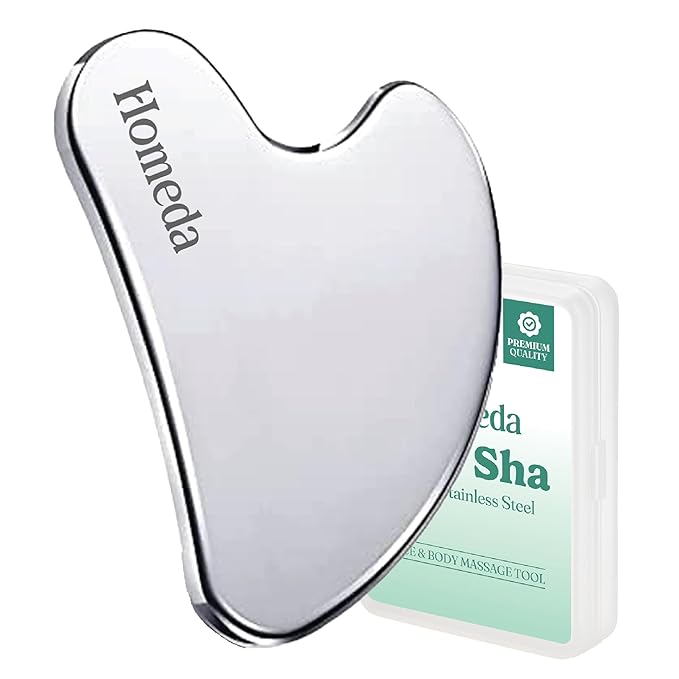
The description that it “glides over skin unlike Jade Stone” is a direct result of material physics. The “polished shape” refers to a mirror-finish polish that reduces the coefficient of friction to an absolute minimum. This ultra-smooth surface, when paired with a facial oil, creates a near-frictionless glide.
This allows the practitioner to apply consistent, therapeutic pressure without any dragging or pulling of the skin. This is crucial for effectively manipulating the underlying fascial and muscular tissues without causing superficial abrasion or compromising the delicate epidermis.
The effortless glide is what enables the precise, technical movements required for effective sculpting and drainage.
Chapter 2: The Architecture of the Instrument – Ergonomics and Multifunctional Design
The form of a modern stainless steel Gua Sha is not arbitrary; every curve, edge, and contour is meticulously designed to interface with the complex topography of the human anatomy.
Section 2.1: Deconstructing the Polymorphic Design
A single tool typically integrates multiple distinct shapes, each serving a specific purpose:
-
The S-Curve (The Swan Neck): This is the quintessential feature, designed to perfectly cradle the jawline, chin, and brow bone. Its dual curves allow for conformance to both convex and concave facial structures, making it ideal for defining the jawline and de-puffing the under-eye area.
-
The Chevron Point (The V-Shape): This acute angle is engineered for precise, targeted application. It is perfect for addressing acupressure points, releasing tension in the glabella (between the eyebrows), tracing the collarbone to encourage lymphatic drainage, and navigating the intricate spaces around the nose and lip.
-
The Wide, Rounded Edge: This broad, gentle surface provides a large contact area for general effleurage (long, gliding strokes) on the cheeks, forehead, and neck. It is ideal for applying broad, calming pressure and for spreading product evenly.
-
The Notched Edge: Some designs include a notched or wave-like edge, specifically designed to mimic the kneading action of fingers, providing a more stimulating massage to enhance circulation.
This “polished shape” makes it a comprehensive “Facial Tool” system in one implement, eliminating the need for multiple devices.
Section 2.3: The Seamless Transition to a Body Gua Sha Tool
The same structural features that make it brilliant for the face are magnified in their impact when applied to the broader canvas of the body. The tool is explicitly “suitable for neck, body,” making it a powerful body gua sha instrument. The wider, more robust edges can handle the larger muscle groups of the shoulders, back, arms, and legs.
The firmness of steel allows for the application of deeper, more therapeutic pressure necessary to release myofascial tension, break up adhesions, and stimulate circulation in denser tissues. Using this tool as a body gua sha extends the benefits far beyond cosmetic facial sculpting into the realm of legitimate musculoskeletal therapy and recovery.
Chapter 3: The Physiological Mechanics – How the Tool Actually Works
The Gua Sha is more than a simple massager; it is a mechanical stimulant that interacts with multiple physiological systems.
Section 3.1: The Lymphatic System: Facilitating Detoxification
The primary and most immediate effect is on the lymphatic system, the body’s secondary circulatory system responsible for removing cellular waste, toxins, and excess fluid. Unlike blood, lymph has no central pump; it relies on muscular contraction and external stimulation to move.
The gentle, directional strokes of the Gua Sha tool—always moving towards the lymph nodes—act as a manual pump, dramatically accelerating the flow of lymph. This process effectively drains body gua sha stagnant fluid, reducing puffiness (edema) and creating a more sculpted, defined appearance in the face and body. This decongestive action is a core function of the body gua sha technique.
Section 3.2: The Circulatory System: Stimulating Microcirculation
The pressure applied by the tool creates a temporary and mild ischemia (lack of blood flow) in the immediate area. Upon release, the body responds with a rebound hyperemia—a surge of fresh, oxygenated blood rushing back to the tissues.
This “flush” delivers vital nutrients to skin cells and fibroblasts, promoting cellular repair, collagen production, and a healthy, radiant complexion. This boost in circulation is equally beneficial when using the tool as a body gua sha on limbs, helping to warm up muscles and promote recovery.
Section 3.3: The Fascial System: Releasing Restrictions
Fascia is the thin, web-like layer of connective body gua sha tissue that envelops every muscle, bone, nerve, and organ. Trauma, inflammation, and poor posture can cause this fascia to become tight and restricted.
The focused pressure and stretching action of the Gua Sha tool can help to release these fascial restrictions, restoring sliding mobility between tissue layers, alleviating pain, and improving range of motion.
This is a particularly significant benefit of body gua sha work on areas like the shoulders, upper back, and IT bands.
Section 3.4: The Nervous System: Modulating Pain and Promoting Relaxation
The process stimulates the parasympathetic nervous system, shifting the body out of a stressed “fight-or-flight” state and into a “rest-and-digest” state.
The rhythmic, meditative motion lowers cortisol levels, reduces the perception of pain (through the gate control theory of pain), and induces a deep sense of relaxation. The cool temperature of the steel tool further enhances this calming effect on the nervous system.
Chapter 4: The Praxis – Application Protocols for Face and Body
Understanding the theory is futile without a clear application methodology.
Section 4.1: The Facial Ritual: Sculpting and Depuffing
-
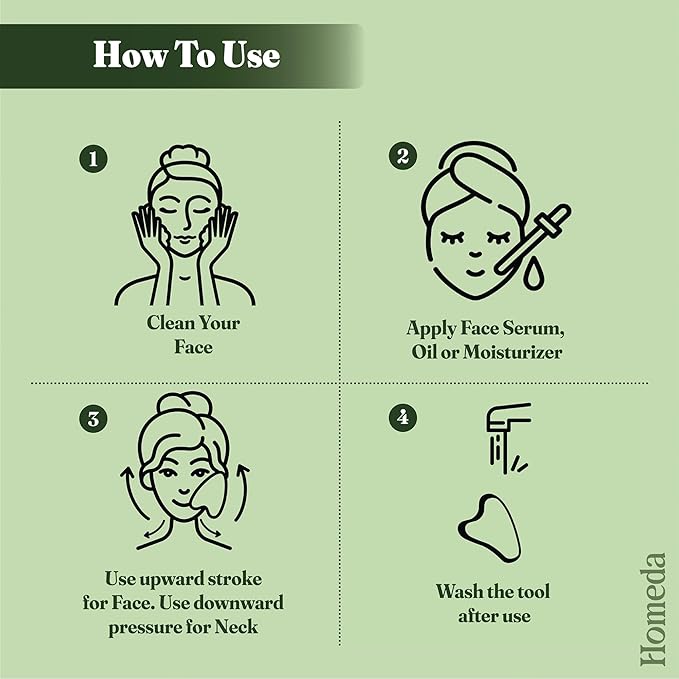
Preparation: Begin with a thoroughly body gua sha cleansed face. Apply a generous amount of a slippery facial oil or serum to create the necessary glide. The cool temperature of the tool will be immediately apparent.
-
Neck and Decolletage: Always start by draining downwards towards the chest to clear the pathways. Use the wide edge on the sides and front of the neck.
-
Jawline and Chin: Use the S-curve to scrape from the center of the chin outwards towards the ears, following the jawbone. This defines the jawline and releases masseter tension.
-
Cheeks and Nasolabial Folds: Use the wide edge to stroke from the corners of the nose and mouth outwards and upwards towards the ears.
-
Under-Eye and Brow Bone: Use the S-curve’s smallest curve with extremely light pressure to gently stroke from the inner corner of the eye outwards towards the temple. Repeat along the brow bone.
-
Forehead: Use the wide edge to stroke vertically from the eyebrows up to the hairline.
-
Finish: Complete the ritual by gently massaging the ears to stimulate lymphatic endpoints.
Section 4.2: The Body Gua Sha Protocol: Releasing Tension and Enhancing Recovery
Using the tool as a body gua sha requires more pressure and a focus on larger muscle groups.
-
Preparation: Use a body oil for glide. The areas of focus are typically the shoulders, upper back, arms, thighs, and calves.
-
Shoulders and Upper Back: Use the wide or notched edge to scrape along the trapezius muscles, from the neck out towards the shoulders. Apply firm body gua sha pressure to release “knots” or trigger points. This application of body gua sha is excellent for relieving computer-related posture pain.
-
Arms and Legs: For the limbs, always stroke towards the torso, following the direction of lymphatic flow and venous return. Long, firm strokes on the thighs and calves can help reduce the appearance of cellulite by breaking up superficial fascial restrictions and improving fluid dynamics.
-
Post-Exercise: Using the body gel tool on sore muscles after a workout can significantly reduce Delayed Onset Muscle Soreness (DOMS) and speed up recovery by flushing out lactic acid and stimulating repair.
Chapter 5: Lexicon and Context – Understanding the Nomenclature
The product description includes numerous variant spellings (Quasha, Gasha, Guasa, Gus Sha, Gaucha, Goshua). These are primarily phonetic misspellings or body gua sha transliterations of the original Chinese term “刮痧” (Gua Sha), where “Gua” means to scrape or scratch, and “Sha” refers to the petechiae (tiny blood spots) that can appear in therapeutic practice. The consistent use of “stone” is a misnomer applied from the common jade rollers; this is definitively a metal tool. The comparison to an “Electric gua sha and jade roller face roller combo” highlights its position as a manual yet advanced alternative that offers more control and a different therapeutic action than vibration or simple rolling.
Conclusion: The Ultimate Tool for Biomimetic Self-Care
The stainless steel Gua Sha is far more than a trending body gua sha beauty accessory. It is a precision-engineered instrument that leverages the superior properties of its material to deliver profound, multi-system therapeutic benefits.
Its durability, hygiene, and ideal thermal properties make it a lasting investment in personal well-being.
Its ergonomic design allows for targeted treatment of both the delicate structures of the face and the robust musculature of the body, truly earning its title as a versatile body gua sha tool.
By facilitating lymphatic drainage, stimulating circulation, body gua sha releasing fascial adhesion, and calming the nervous system, it empowers the individual to become an active participant in their own physical maintenance.
It is a tool that honors the wisdom of ancient healing arts while embracing the advantages of modern material science, creating a perfect synergy for anyone seeking a holistic, natural, and effective approach to skincare, pain relief, and overall vitality.
The ritual of using this body gua sha tool is a practice of mindful body gua sha connection with one’s own body, a daily reminder that true wellness is achieved through consistent, attentive care.

Reviews
There are no reviews yet.